The Vacant Sky: James Turrell and the Mind That Needs to Wander
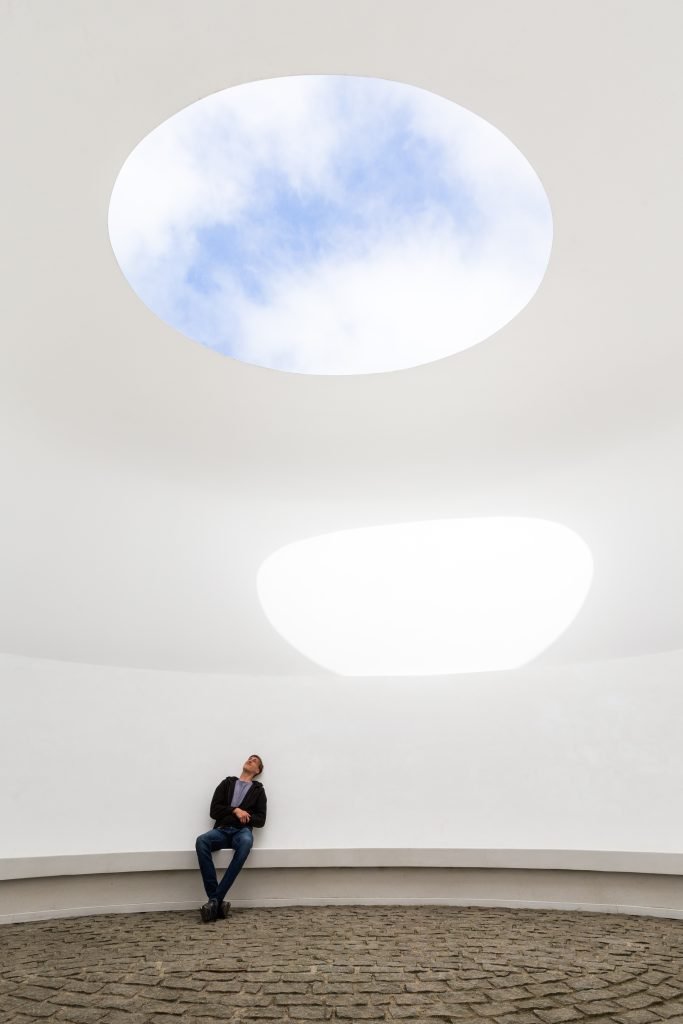
Tewlwolow Kernow; an elliptical domed ‘Skyspace’ chamber designed as a space from which to view the sky
"I want you to sense yourself sensing."
- James Turrell
James Turrell began reshaping Roden Crater in 1977. He carved rooms within the very core of a volcanic cone in the Painted Desert of Arizona. Nearly fifty years on, he 's still tunnelling into its ancient body, carving chambers that funnel starlight, cutting apertures in the rim so that the naked eye can perceive the sky not as weather or backdrop, but as something almost physical. People describe entering the space as close to vertigo, close to awe. The sky becomes something you can almost touch.
I haven't experienced Roden Crater myself, though I've sat in several of Turrell's installations. They're humbling, soothing in design, and sensorially provocative, built to cultivate what I'd call solitudinal presence. That sense of individuated awareness is something I'm increasingly self-conscious about. I meditate on how comfortable I feel with my own company, my own mind, especially when I'm struggling to access imagination or that mode of thought I need for real work. When I'm rushed, pressured, or my imagination feels flattened, there's now an almost reflexive reach for an AI prompt. We've developed a deep intolerance for the vacant sky of the mind, and I think we're paying for it in ways we can't yet fully understand.
What the Brain Does When You Stop Feeding It
The neuroscientist Andrew Huberman has been persistent on this point: our productivity culture ignores boredom entirely. It treats boredom as failure, as wasted time. But boredom isn't a failure state. It's generative. When the mind is genuinely deprived of input, not merely handed a different screen, what neuroscience calls the default mode network activates. The brain doesn't go quiet. It goes inward and begins the slow, associative, nonlinear work that directed attention cannot perform: connecting disparate memories, rehearsing possible futures, constructing novel configurations of ideas and feelings. Creative thought eventually emerges from this work.
The default mode network exists in a set of brain regions that activate not when we're focused on a task, but when we're not. Identified in early fMRI studies, it governs mind-wandering, autobiographical memory, future simulation; the capacities we've largely learned to suppress in favor of measurable productivity. Neuroscientists initially dismissed its activity as neural 'noise.' They now understand it as central to imagination, empathy, and creative insight. The research is now fairly robust: a period of allowing the mind to wander measurably increases subsequent creative problem-solving. The mechanism is something like fermentation. Nothing is visible, yet the conditions for something extraordinary are being established. The tragedy of our current moment is that we've become afraid of the fermentation stage. We mistake its apparent emptiness for waste.
The Architecture of Attention: Turrell and Rubin
Turrell understood this long before the default mode network had a name. His 'Skyspaces' function as spatial machines for enforcing precisely this state. There's nothing to do in them. Nothing to read, nothing to respond to, nothing to prompt you into action. There's only the slow shift of light and the growing awareness of your own act of perceiving. You become conscious of consciousness. Something opens up. Rick Rubin says something similar, though his argument sounds almost mystical until you realise it's deeply practical. In 'The Creative Act,' he writes that the artist's primary job isn't to produce but to receive. To cultivate a quality of openness so that when something genuinely new wants to arrive, there's clear space for it to enter. "The universe is only as large as our perception of it," he writes. Shrink the space of perception, and you shrink the universe from which your work can be drawn.
What Rubin describes is perhaps a secular account of what Turrell engineers architecturally. Both are in the business of creating conditions for a particular quality of attention, not the sharp, directed attention of problem-solving, but the wide, patient, slightly unfocused attention of genuine receptivity. The attention you bring to a sky that asks nothing of you. The attention that, given enough time and silence, begins to notice things. The AI prompt, in this light, isn 't simply a tool. It's a subtle enemy of this state. Not because of the outputs it generates, but because of what it forecloses. Every time we fill the silence before an idea has properly formed, we deprive ourselves of the incubation period it requires. We get 'something' instead of 'nothing'. The something, however polished, isn't ours. It hasn't passed through our particular neural weather; it hasn't been shaped by the specific pressure of our experience and uncertainty. In Rubin's terms, it's been received from a different universe, one other than our own.
The Productive Ache of Not-Yet-Knowing
AI can extend the reach of a thought already formed. It can articulate a half-intuited structure. It can function as a brilliant and tireless interlocutor for ideas that have already passed through the necessary crucible. The question isn't whether to use it. The question is when. What I'm resisting is premature resolution: the habit of reaching for a response before the generative discomfort of not-yet-knowing has had time to work on us. We've built a machine that eliminates the productive ache of not-knowing with extraordinary efficiency. Whether that ache was doing something we can't afford to lose, that's the real question.
Huberman's neuroscience suggests it was. The default mode network, activated precisely in the fallow, directionless, faintly uncomfortable state of doing nothing in particular, isn't ancillary to creativity. It's creativity's substrate. The visual cortex, unoccupied by external input, begins to generate internally. The hippocampus pulls threads from memory that the focused mind would never have associated. Novel configurations emerge, tentatively, at the margins of awareness.
This is what Turrell gives his visitors inside 'Roden Crater'. He's creating engineered conditions for people's own brains to do the work only their brains can do. The sky he opens above you isn't empty. It's full of what you bring to it. Turrell has spent half a century making the case that looking at nothing is one of the most demanding and rewarding acts available to a human mind. He's right. And the urgency of that case has only intensified in an era that offers, at the tap of a finger, something in place of nothing.
I keep questioning whether AI will diminish human creativity. The record of technology's relationship to creativity is too complex for such fatalism. The real question is whether we'll retain the discipline to sit with the vacant sky long enough for it to become full. Whether we'll remember that imagination, like the default mode network itself, requires a particular quality of emptiness to do its deepest work. That patience isn't passivity. That boredom, properly inhabited, is the beginning of everything.
