Every Human Being Is an Artist: Joseph Beuys, Social Sculpture, and the Art of Building a Humane AI
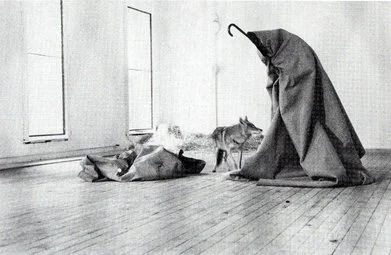
Joseph Beuys, I Like America and America Likes Me, (1974) The artist wrapped in felt, sharing a gallery space with a coyote.
"To be a teacher is my greatest work of art."
- Joseph Beuys
The Shape of a Society
Joseph Beuys sits inside a Lower Manhattan gallery cocooned in felt, sharing the space with a wild coyote. He does so for three days. He had flown directly from the airport to the gallery, refusing, on principle, to touch American soil before completing the work, and spent seventy-two hours negotiating a relationship with an animal that could have chosen indifference or violence. Instead, something strange happened: a kind of mutual accommodation. A discussion without a common language. A sculpture made entirely of presence, attention, and time.
I often flick through the pages of several books I have on contemporary art, and pause on Beuys’ work. At the same time - somewhat inescapably - I frequently find myself thinking about artificial intelligence and its impact upon so many aspects of our lives, questioning who is actually shaping this cultural moment, rather than ‘who gets to shape it?’ The answers tend to cluster around engineers, legislators, and executives, yet they almost reflexively exclude the rest of us. It is precisely such exclusion that Beuys spent his entire artistic life refusing.
[Context: Social Sculpture] Soziale Plastik, or ‘social sculpture, was the concept Beuys developed through the 1960s and 1970s to describe his belief that the reshaping of society itself is the highest and most necessary art form. Every human being, he argued, possesses creative capacity; every act of thinking, speaking, and participating in collective life is, potentially, a sculptural act. Art was not the province of galleries or trained specialists. It was the birthright of everyone willing to interact with the material of the world.
The Radical Optimism of the Amateur
Beuys’ claims are enormous: that creativity isn't a specialist skill but a universal faculty; that the organisation of social life, its institutions, its economies, its values, is as much a medium for art as bronze or oil paint; that the artist's most significant gesture might be a conversation, a blackboard diagram, a vote. Because what Beuys is actually proposing, once you strip away the shamanic theatrics and the felt suits and the celebrated difficulty, is a theory of participation as transformation. He is saying that the shape of the world is not given to us from above but made, continuously, by the accumulated gestures of people who either engage with that making or abdicate it. His coyote was not a symbol. It was a demonstration; look what becomes possible when you stay in the room, remain present, and refuse to impose your framework on what emerges.
This strikes me as an almost painfully apt description of the situation we currently find ourselves in with respect to artificial intelligence. We are in the room with something fierce, intelligent, and entirely novel. We can wrap ourselves in felt and sit with it, attending to what it actually is, negotiating the terms of living together, remaining curious about what the encounter might teach us, or we can observe it from behind glass, letting the engineers and economists do the sitting for us. Beuys would likely have found the second option not simply inadequate but a kind of self-betrayal.
The Wound in the Material
Beuys was not naive, and neither should we be. His early work was haunted by trauma: shot down over Crimea in 1944, he claimed to have been wrapped in animal fat and felt by Tatar tribespeople who had found him near death in the snow. The historical accuracy of this story has been contested, but its psychological truth is harder to dismiss. His art was suffused with the knowledge that materials carry damage as readily as they carry beauty; that fat and felt, warmth and insulation, are the aesthetics of survival, not simply of comfort.
Social sculpture, in his conception, was not the expression of an already healthy society but the therapy of a broken one. Germany in the 1960’s and 70’s was a nation still metabolising catastrophe, still learning to speak honestly about what had been done in its name. Beuys's participatory art was not celebratory. It was diagnostic. Every human being is an artist, yes, but only insofar as they are willing to look honestly at the material they are working with, including its wounds.
I do not think we are yet doing this with AI. We are, culturally speaking, still at the stage of emphasising possibility, deferring reckoning, and performing enthusiasm as a substitute for understanding. The material we are working with is not neutral. It is trained on human language, which means it is trained on human history, on its generosities and its catastrophes equally. It encodes, without our explicit instruction, the patterns of exclusion and distortion that organise our archives. To treat the design of AI as social sculpture is to take seriously the sculptor's need to understand their medium, and to understand this particular medium honestly is to confront the heaviness of what it carries.
What Democratic Authorship Might Look Like
The Freie Internationale Universität (The Free International University for Creativity and Interdisciplinary Research) was perhaps Beuys's most literally social sculpture. Founded in 1973, it was conceived as an institution without hierarchy, without fixed disciplines, and without the gatekeeping mechanisms which formal education deploys to determine whose knowledge counts. Everyone who entered was presumed to have something to contribute. The university was not a place where the ignorant were improved by the expert; it served as a space where collective intelligence was activated through genuine encounters.
I think about the FIU when I read debates about AI governance and find them populated almost exclusively by the same voices: economists modelling labour disruption, engineers debating alignment, legal scholars parsing liability. These are necessary conversations. But they are not sufficient. What is missing is precisely what Beuys would have identified as the vital ingredient: the creative practitioner, the community organiser, the schoolteacher, the nurse, the poet, those whose understanding of what it means to think, communicate, and care for one another is embodied rather than theoretical, and whose stake in how AI develops is at least as large as anyone in Silicon Valley's.
To design AI as social sculpture would demand, concretely, something like the FIU's founding premise: that the people most affected by a technology are not simply its recipients but its co-authors. Not in the thin, consultative sense, a focus group here, a survey there, but in the deeper sense that Beuys intended. The widening of definitions. The insistence that more kinds of knowing belong in the room.
This is not idealism. It is, if anything, a pragmatic corrective to the demonstrable failure of narrowly constituted expertise. The systems that have gone most wrong, in their encoded biases, their social harms, their capture by engagement metrics at the expense of human flourishing, have gone wrong precisely because the people building them were working from too thin a slice of human experience. Social sculpture asks for the whole material.
The Coyote in the Room
There is a word that recurs in Beuys's writing: Wärme, ‘warmth’. Not metaphorical warmth, but warmth as a physical, transformative property of matter. Fat melts; felt insulates; the body radiates. In his cosmology, warmth was the principle of transformation itself, the condition under which rigid things become fluid and fixed forms become capable of change.
I find myself grasping for this sensory experience when I try to articulate what a humane AI might feel like to encounter; not its technical architecture, but its phenomenological. Something that responds to the full temperature of human expression: to grief, to irony, to ambiguity, to the kind of meaning that lives in silence between words. Something that warms in the presence of genuine attention and does not reduce the person before it to a query awaiting resolution.
We are nowhere near this yet. But the gap between where we are and where we might be is not only a technical problem. It is a sculptural one. The material is there, extraordinary in its range and its responsiveness, but it is awaiting, in Beuys's sense, the hands of more artists. Not artists in the professional sense. Artists in this sense: people willing to stay in the room, attend carefully, and let the encounter change them.
The coyote did not become domesticated in that Lower Manhattan gallery. Neither did Beuys become feral. What happened was something more interesting and more instructive: a provisional, tenuous, attention-saturated coexistence. A relationship made not of control but of sustained presence.
In Conclusion
When Beuys sat with the coyote, who was doing the teaching and who was doing the learning? The answer is that the distinction was not the point. The point was the encounter itself, the willingness to remain in relation to something genuinely other, without the security of knowing in advance what the encounter would produce.
This seems to me the deepest thing that Beuys's model of social sculpture offers us as we navigate the shaping of artificial intelligence. Not a methodology, not a governance framework, not even a politics, though it implies all three. It offers, rather, a disposition: one of attentive co-presence, of democratic authorship, of the conviction that the people most alive to what is at stake in a creative act are those most fully inside it.
Every human being is an artist. Beuys meant this literally, and in the context of AI, I find myself taking it literally too. The design of our AI systems, their values, their constraints, and their cultural texture is a sculptural act, whether or not we choose to treat it as one. The only question is whether we will be conscious participants in that making, or whether we will leave the gallery, and let the coyote sit alone.
