The Pollen and the Algorithm: Staying Present When Everything Accelerates
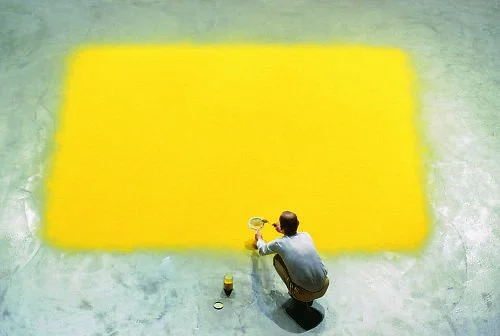
Wolfgang Laib, Pollen from Hazelnut, 2002 (5 jars of hazelnut pollen)
"You have power over your mind, not outside events. Realise this, and you will find strength."
- Marcus Aurelius, Meditations, c.180 AD
An Artist Who Collects Time
Every morning, from early spring through summer, Wolfgang Laib goes into the fields near his home in southern Germany with a small glass jar and a fine-mesh sieve. He collects pollen: dandelion, hazel, pine, moss, buttercup. He collects a few grams at a time, jar by jar, year after year, over decades. In time, what he collects, he then brings it inside, patiently sifting it across the floor of a gallery, into vast, glowing rectangles of yellow. Several metres of pure, accumulated slowness. Laib does not use AI tools to design his installations. His work cannot be automated. It cannot be hurried. Each piece is made carefully, from years of early mornings, from the disciplined accumulation of what, in principle, could not be done any other way.
Laib's work, specifically those pieces using pollen, is increasingly coming to mind of late. They are visually alluring and serene. I find them highly meditative. But they also represent something I am increasingly desperate to hold onto; the idea that there are forms of value that exist entirely outside the current, modern-day “logic” of acceleration.
[Context: Stoicism] An ancient Greek and Roman philosophy founded around 300 BC by Zeno of Citium, and later developed by Roman thinkers including Seneca, Epictetus, and Emperor Marcus Aurelius. Stoicism teaches that while we cannot control external events, we always retain control over our own responses, judgements, and values. The Stoics distinguished between what is 'up to us' (our inner life, our choices, our character) and what is 'not up to us' (the behaviour of others, external circumstances, the passage of time). The practice of Stoicism involves training the mind to stay focused on the former and remain equanimous toward the latter.
The Stoic Argument Against Panic
The Stoics were not escapists. Marcus Aurelius wrote his ‘Meditations’ while running an empire at war. Epictetus composed much of his philosophy in slavery. They were not theorising from places of comfort; they were developing practical methods of self-preservation in conditions of radical uncertainty, conditions not entirely unlike our own.
What Stoicism offers to us in the AI age is not a technique for ignoring change, but a philosophical framework for identifying what is actually at stake. The Stoic question is: what, during the acceleration of AI, is genuinely within my control, and what is not? The answer, if we are honest, quickly finds itself. I cannot control the pace of its development. I cannot control how businesses deploy these systems, or how governments regulate (or don’t regulate) them, or what the next breakthrough will be. What I can control is the quality and character of my own attention and intention. What I choose to “feed” it, what I choose to make with it, and how I choose to relate to it. This is not a matter of passivity. This is the radical act of refusing to let the pace of the external world set the tempo of the internal and personal one.
Pollen, and the Practice of Irreducible Time
Laib's creative practice embodies Stoicism. His daily discipline of collection, patient, non-negotiable, inseparable from the passage of seasons, is one of attending to what is genuinely present rather than perpetually anticipating what is next. The pollen field cannot be produced by thinking about producing it, created in a moment of prompting. It requires the body in the field, in the weather, at the specific unhurried pace of a small jar being filled.
There is something that feels almost shocking and inconceivable about the slowness of this pace. Laib's pollen fields are a proof of concept; there are forms of value and meaning that exist entirely outside the logic that AI embodies and accelerates. Optimisation, efficiency, scalability, and speed are not nostalgic; rather, they are urgently contemporary. The Stoics would likely have recognised in Laib's practice what they called askesis, disciplined self-cultivation through repeated, intentional action. Marcus Aurelius spent time every morning with his journal, not because it changed the empire, but because it changed him, sharpening his capacity to meet the empire's demands from a position of interior steadiness. Laib spends his mornings in the field not because the pollen cannot wait, but because he can.
In Conclusion
In an age of aggressive entropic change, driven by AI and other technologies, presence is not a luxury. Presence is a primary skill. It is something that cannot be delegated to a machine, outsourced to a platform, or accelerated beyond the pace of a human nervous system's capacity to actually be somewhere. Laib's fields take years. They take the irreplaceable duration of a life.
