The Citadel Within: AI, Creativity, and Our Stoic Responsibility
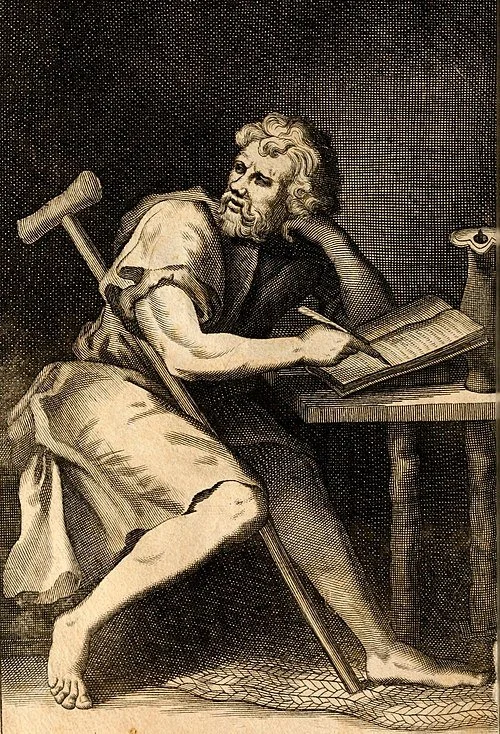
"Some things are in our control, and others are not."
- Epictetus, Enchiridion, c. 125 AD
There is a very particular discomfort I notice when someone describes a piece of work as their own, even though every sentence of it was clearly composed by a machine. It is not simply an aesthetic “distaste”. Perhaps it’s something closer to grief. Akin to witnessing a person hand away something precious without quite realising what they have given up.
We are living through a moment of creative anxiety; conversations fizz between short and long-term employability, and the longevity of entire sectors. The AI tools that are now available are genuinely extraordinary. I admit to using them. But I believe the ease with which we can now outsource our thinking, our writing, our imagining, our designing, constitutes not simply a practical risk but a moral one. And the Stoic tradition has given me the clearest language for why.
[Context: Stoic Philosophy] Stoicism was a school of Hellenistic philosophy founded in Athens around 300 BC, later developed by Roman thinkers including Seneca, Epictetus, and Marcus Aurelius. At its core is a distinction between what lies within our control: our judgements, impulses, desires, and responses, and what does not: external events, others' opinions, and circumstances. Living well, the Stoics argued, means concentrating our energies entirely within the former domain. The inner life is the only domain of genuine freedom.
What Is Ours to Keep
Epictetus opens the ‘Enchiridion’: “Some things are in our control, and others are not”. The Stoics called the domain of genuine control the hegemonikon, or the ruling faculty, the seat of reason and will; the “citadel within”. And what did they place there, at the centre of a human life? Judgement. Desire. The creative response to the world. The capacity to think, feel, and choose with intention.
Our creativity is what I would position front and centre. It is not a skill we possess, the way we might possess or wield a hammer or a spreadsheet. It is constitutive. It is the way our particular consciousness meets the world we live in, and subsequently makes something of that encounter. To hand it wholesale to a system that neither meets the world nor inhabits anything within it, is not efficiency. It is, in the truest, most Stoic sense, a kind of self-abandonment.
This is not technophobia. The Stoics were not opposed to the effective use of tools; Marcus Aurelius governed an empire with every instrument of administrative power at his disposal. The question was always how a tool might serve a rational, purposeful life, and whether it enlarged or diminished the “inner citadel”.
The Poetic Culture AI Cannot Inhabit
We live in a world irreducibly poetic; in the older Greek sense of poiesis, of making and bringing forth. Humans have always made meaning from their suffering, discovered beauty from confusion, and made connections from aloneness. This is not a luxurious function that evolved late. It is what we do when we do everything else.
A large language model (LLM) generates text by predicting statistically plausible follow-ups to prompts. It does this with impressive fluency. But fluency is not voice. Voice emerges from a “self” formed by specific lived losses, specific loves, specific failures of understanding, and hard-won recoveries of meaning. A large language model (LLM) has processed ten thousand voices. It has not lived carrying the burden of actually being one.
Seneca, writing to his friend Lucilius about the importance of a distinct style, warned against absorbing so many influences that one's own voice disappears; the mind that belongs to everyone, he wrote, belongs to no one. He was speaking of reading and imitation, yet he might as well have been speaking of prompting. The risk is not that AI writes badly. The risk is that we stop writing altogether and forget what we sounded like.
A Responsible Middle: Optimise, but Do Not Outsource
I’m not arguing that workplaces should turn their backs on AI tools, or that using them is somehow morally suspect. The operational possibilities are real. Automating repetitive administrative tasks, synthesising large bodies of information, recognising patterns in data, and accelerating research are all legitimate and often genuinely liberating uses. A writer who uses AI to research a piece more efficiently has not abandoned their voice. They have sent a very fast research assistant to the library.
[Context: AI and Employment] Concerns about AI-driven unemployment are considerable and serious. The McKinsey Global Institute has estimated that generative AI could automate tasks that account for significant portions of work across sectors, including marketing, legal research, software development, and the creative industries. The debate turns on whether AI will augment human roles or replace them wholesale, and who, structurally, bears the cost of that transition.
The distinction is between ‘optimisation’ and ‘outsourcing’. To optimise is to use a tool so that more of your human attention and energy is available for the things only you can do. To outsource is to assign those very things to the tool, and to forget - or never quite learn - that they were yours to begin with. The first is a reasonable deployment of intelligence. The second is, in my opinion, a form of dereliction.
The fears of mass unemployment in the face of advancing AI use are not imaginary. But our response to their use cannot be limited to structural measures; it must also involve regulation, retraining, and redistribution. It must also be philosophical. Marcus Aurelius, facing a civilisation in permanent crisis, returned again and again to a single discipline; that the quality of our engagement with our work matters, irrespective of outcome. That we owe it to ourselves, and to each other, to bring our whole capacity to whatever we are doing.
In an era when AI can produce acceptable work in seconds, the most radical thing a person can do is insist on producing their own. Not out of Luddite sentiment, but out of Stoic conviction. The work of thinking, making, and imagining is not a means to an output. It is part of what it means to live well. It belongs inside the citadel.
In Conclusion
The Stoics did not counsel passivity in the face of difficulty; they counselled clarity about what we can and cannot govern. We cannot prevent AI from being capable. We cannot legislate away its facility with language, or image, or code. These things are not in our control(?) What is within our control is whether we use it to augment our thinking or to replace it(?) Whether we treat it as a powerful instrument in the service of a considered life, or as an alibi for not living one.
The citadel is not taken by force. It is surrendered, incrementally, each time we defer to the machine what we might - with effort, love, and genuine engagement - have done ourselves. The creative and poetic culture we have inherited is not a given. It was made by people who brought themselves entirely to the act of making. The question AI puts to each of us is a very old one, wearing new clothes: what do you consider worth the effort of being human?
