What the Romantics Would Have Made of Our Digital Sublime
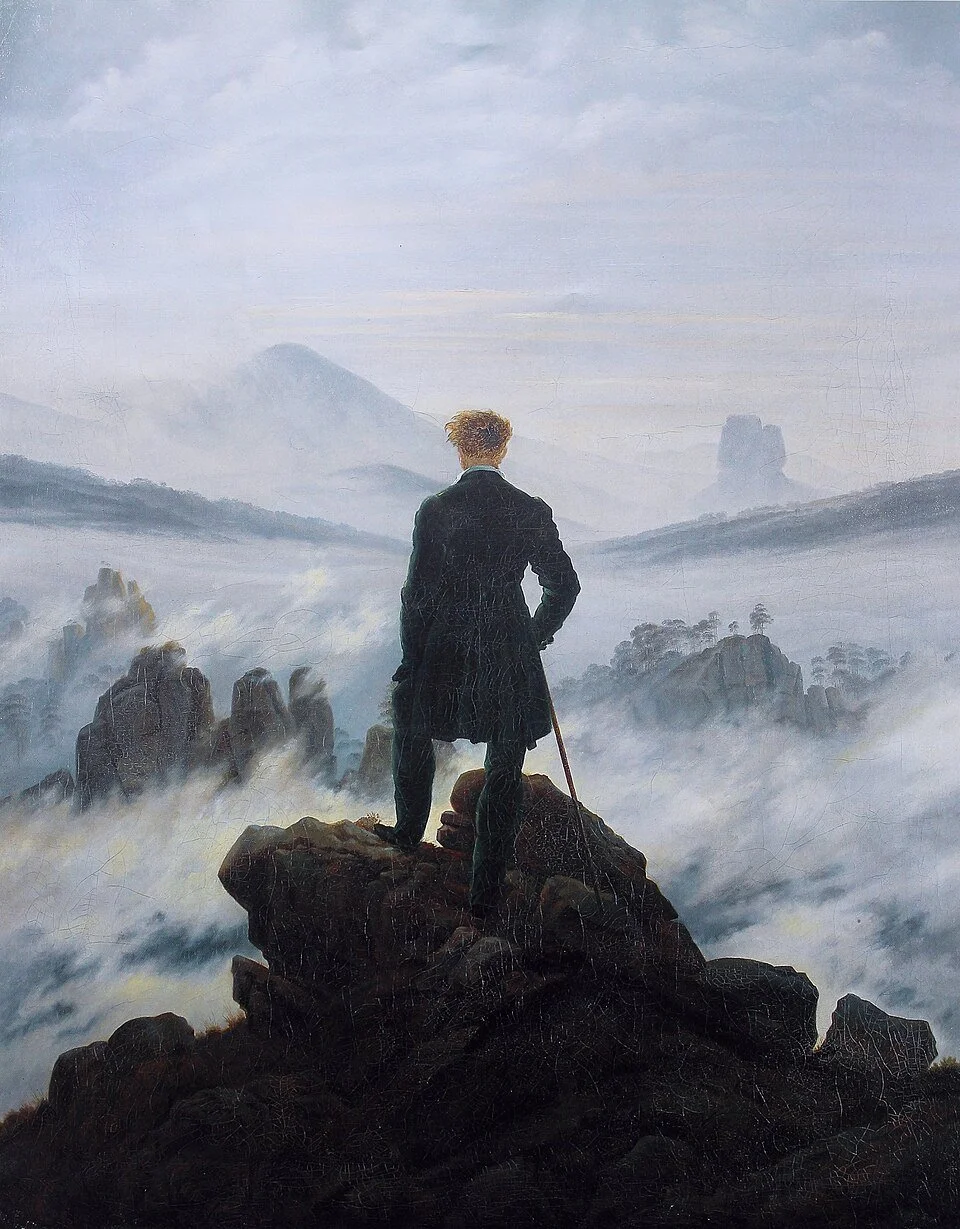
Caspar David Friedrich, ‘Wanderer Above the Sea of Fog', (1818)
Imagine, for a moment, that Wordsworth had a Twitter account. Or that Keats, dying by degrees in his Roman apartment, had access to a language model trained on every elegy ever composed, able to produce, in seconds, a facsimile of the 'Ode to a Nightingale' he was struggling to write through blood-specked coughs. Imagine that Caspar David Friedrich, instead of walking for days through the Rügen cliffs to find the precise angle of light he required, could simply type his vision into a prompt and receive it rendered in seconds. What, exactly, would have been gained? And what would have been irreparably lost?
The Romantic movement of the early nineteenth century was not merely an aesthetic preference. It was a philosophical revolt. It arose in direct opposition to the forces of industrialisation and Enlightenment rationalism, the mechanisation of labour, and the instrumentalisation of nature. The Romantics were reacting against the machine. Today, we are seemingly doing the opposite.
[Context: The Romantic Sublime] The concept of the 'sublime', central to Romantic art and philosophy, describes an experience of overwhelming vastness, power, or beauty that transcends ordinary aesthetic pleasure and produces a complex mixture of terror and awe. Edmund Burke (1757) associated it with darkness, obscurity, and the sense of one's own smallness before nature. Immanuel Kant (1790) later argued that the sublime ultimately reveals the human capacity for reason as superior to nature's power. For the Romantics, Wordsworth, Coleridge, Shelley, Byron, and painters like Friedrich and Turner, the sublime was encountered above all in wild nature: mountains, storms, raging seas, and the sky at night.
The Machine That Cannot Wander
Wordsworth walked. He walked obsessively throughout his lifetime, over 180,000 miles, according to one of his biographers. His poetry was composed in motion: cadence derived from the body moving through the landscape, meaning shaped by encounters between the inner life and the outer world. Artificial intelligence cannot wander. It can simulate wandering, can produce texts inflected with the sensation of movement through space, but it cannot be changed by the experience of a particular light on a particular hillside at a particular moment, in a particular life. The Romantics placed supreme value on exactly this kind of irreplaceable particularity. Coleridge's 'conversation poems' were addressed to specific people, in specific places, at specific hours. Their meaning is inseparable from their occasion. No algorithm can replicate the specific, unrepeatable weight of a moment.
They Would Have Rejected It, and Then Written About It Anyway
The Romantics were fascinated by monstrosity, by the consequences of transgressing what was natural, by the creature that escapes its creator's intentions. Shelley, after all, gave us Frankenstein, written by his wife Mary, yes, but in a household soaked in Shelley's own obsessive interrogation of the limits of human creation. They were not innocent of the future. They were writing its first drafts.
Turner, ambiguous and restless as ever, painted the industrial locomotive not with horror but with the same atmospheric, luminous uncertainty he brought to the sea and the Alps. He did not reject the machine; he absorbed it into his aesthetic vocabulary, asking what it looked like from within its own myth. I think this is the most Romantic response available to us now: not rejection, not uncritical celebration, but the insistence on asking what it looks like when we refuse to let the algorithm tell us who we are. The Romantics would have walked away from the screen. But they would have come back, eventually, to write the poem about why they left.
In Conclusion
The Romantic legacy is not nostalgia. It is a persistent insistence on the irreducible importance of the embodied, mortal human encounter with a world that is not made for us, but which we have the extraordinary capacity to be moved by. In an age when AI offers to simulate every creative act, the most Romantic gesture available to us might simply be this: to go outside, to be in the weather, and to notice that you are there in a way no machine ever will be.
