After the Splash: Mapping AI's Three Waves of Displacement
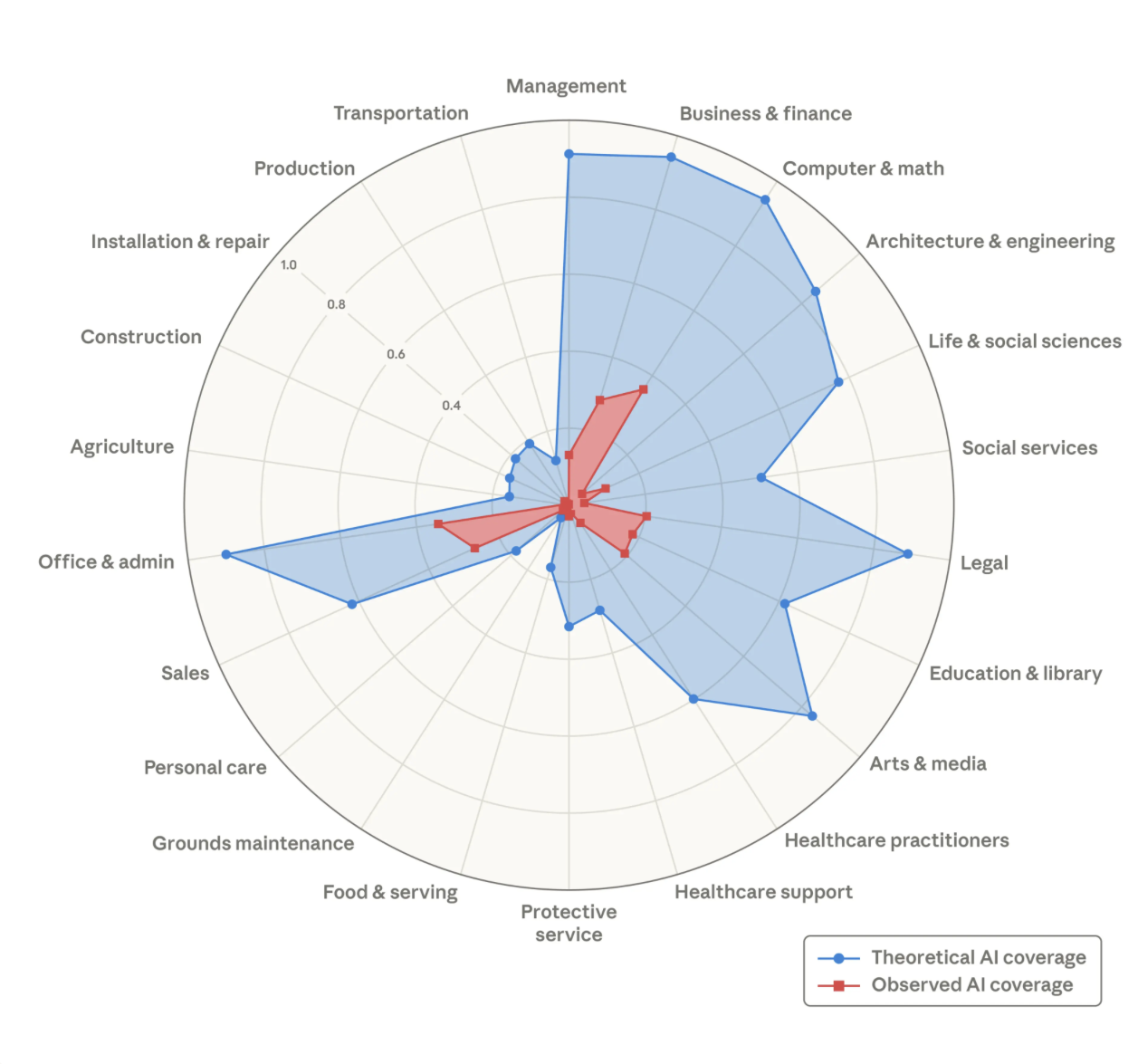
Anthropic's 2025 study: the gap between observed and theoretical AI coverage, the distance between where the ripple is, and where it is going.
There is something meditative about the moment a pebble meets still water. A clean, decisive movement, the pond holds the impact. The first ring appears, expanding outward with a quiet inevitability. It is easy to forget that the movement will keep going, long after the stone has settled into the silt, even long after the eye can no longer perceive the water’s movement.
I recently came across Anthropic’s recently published diagram of artificial intelligence's theorised reach across occupational categories, plotted against what it is actually, currently being used. The red outline, that traces observed AI usage, is modest, almost reassuring. The blue outline, marking theoretical capability, in comparison is vast and asymmetric, extending far beyond anything we have yet felt. Between those two shapes lies the distance between the splash and the spreading rings. And the rings are already moving. What if we follow the water outward, and look not just at where the first wave has broken, but at where the second and third are building, still beneath the surface, still yet to be wholly perceived. What if we ask whether there is any way to stand in the water differently?
The First Wave: What the Red Outline Already Tells Us
The diagram is striking in what it reveals about the first wave's contour. Observed AI adoption clusters around a recognisable set of professional categories: management, business and finance, computer and mathematics, legal work, office administration, arts and media; occupations defined by language, pattern recognition, synthesis, and the manipulation of symbolic information. They are the careers that a certain class of educated worker was once told would be safe from automation; the factory floor was vulnerable, the knowledge economy was not.
The red outline quietly demolishes that comfort. What has happened in these sectors is not the crude replacement of repetitive physical tasks but the beginning of something subtler: the erosion of the cognitive middle. Paralegals who once spent hours synthesising case law, junior analysts condensing financial reports, junior copywriters building the first draft, are all finding that the tasks which constituted the early phase of their professional career are now being automated. This is not a catastrophic displacement in any single industry's headline figures. It is, rather, the slow withdrawal of the entry-level cognitive work that once trained people to become experts. The first wave does not drown anyone. It soaks the floor on which the next generation was supposed to learn to walk.
The metaphysical stakes of this are under-appreciated. Expertise is not only the accumulation of declarative knowledge, but of tacit knowledge; the understanding that accrues through making mistakes on small things before being trusted with large ones. When the small things are automated away, the pipeline of tacit formation is interrupted. We may, in a decade, find ourselves with a professional class rich in senior talent and bereft of the middle-layer that should have followed.
The Second Wave: Education, Care, and the Illusion of the 'Human Exception'
The theoretical blue of the diagram extends toward education and library work, social services, and healthcare support. These are sectors have long been held up as the human exception; work so saturated with relational nuance, ethical judgment, and contextual sensitivity that no statistical engine could substitute for it. Yet it feels like the second wave is already gathering, though its character is entirely different from the first.
It will not arrive as a replacement. It will arrive as an augmentation that gradually shifts the nature of the role until the role itself is transformed. Consider the teacher whose students already use AI tutoring platforms outside of school hours, platforms that are infinitely patient, endlessly adaptive, available at three in the morning. The teacher's value is not eliminated. It is redistributed toward the affective and motivational dimensions of learning that no system yet replicates with any reliability. But what happens when those dimensions begin to be approximated? What happens when the AI counsellor is genuinely good at “holding space”?
It may of course, not happen. However, the second wave's damage - if it comes - will be philosophically more disorienting than the first, because it will challenge not just our livelihoods but our accounts of what we are for. The legal clerk can retrain. The teacher who discovers that presence itself has been commodified will be asked to answer a deeper question about the value of human attention, in a world that can now simulate it. The second wave does not steal jobs. It steals the philosophical scaffolding on which we built our sense of irreplaceability.
The Third Wave: The Physical World, and Questions We Have Not Yet Thought to Ask
The third wave may, in some ways, be the most counterintuitive. The diagram shows construction, agriculture, personal care, food and service, and grounds maintenance as sectors of minimal observed or theoretical AI penetration. These are the categories that survived the first industrial revolution, and the digital in turn. They survived because they require the kind of embodied intelligence - spatial reasoning, haptic sensitivity, adaptive physical response to unpredictable environments - that has historically been beyond the reach of any machine.
But robotics is not AI, and yet AI increasingly animates robotics. The trajectory of humanoid robots (such as Boston Dynamics, Figure, and Tesla's Optimus) suggests that such an embodied exception is not permanent; it is merely expensive. And as the cost curves fall - which they always do - the third wave will begin to form in the sectors we had most confidently assumed were safe. The plasterer, the care worker who turns a patient in the night, the agricultural hand who navigates uneven terrain and reads the weather in the soil, none of these are inevitable casualties. But their immunity, which felt structural, is beginning to feel merely temporary.
Here is where the question becomes not economic but civilisational. The first wave displaces symbolic workers, and we renegotiate the knowledge economy. The second wave displaces relational workers, and we renegotiate the meaning of human care. The third wave, if or when it arrives, displaces the last category of work that requires a body in a specific place. Then we are left asking something no government white paper has yet seriously addressed: what is the social function of labour, independent of its economic function? What happens to communities when the requirement to participate physically in the making of the world is removed? We have spent two centuries asking how to make work more efficient. We have not yet seriously asked what work is for.
In Conclusion
Conventional responses to technological displacement are well-rehearsed: Universal Basic Income, retraining programmes, a four-day work week, and the taxation of automation. These are serious proposals and deserve serious consideration. But what strikes me is that they all accept the frame; that the human relationship to productive activity is primarily economic, and that the problem of displacement is therefore primarily one of income substitution or skill migration. What if that frame is itself part of what the three waves of disruption will make untenable?
What if, instead of asking how we replace the income that labour provided, we ask how we redesign the social architecture around what labour has always also been: a source of structure, of identity, of contribution, of the sense that one's presence in the world makes a material difference? What if we stopped asking how to protect jobs and started asking what human beings need to feel they matter?
I am increasingly convinced that the people who will navigate the three waves with least damage are not those who retrain fastest, nor those protected by the most generous safety nets, but those embedded in communities and practices that can sustain a meaningful life independent of the market's verdict on their labour. The pebble is in the water. The rings are spreading. The question is not whether they will reach us. It is what we will build on the far bank, where the water eventually stills.
