

The Urinal and the Algorithm: How AI Distorts the Reality It Presents
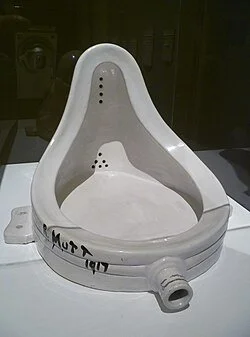
Marcel Duchamp, Fountain, 1917
"I threw the bottle rack and the urinal in their faces as a challenge and now they admire them for their aesthetic beauty."
- Marcel Duchamp
In 1917, Marcel Duchamp submitted a porcelain urinal to the Society of Independent Artists' open exhibition in New York. He called it ‘Fountain’, signed it R. Mutt, and waited. The object itself was unchanged, a mass-produced sanitary fitting, identical to ten thousand others. What changed was the context. The pedestal. The institutional frame that leaned over it and said, “this is worth attending to.”
I've been thinking about ‘Fountain’ a great deal while watching how we receive AI-generated content. Not because AI is unworthy of serious attention, it is clearly one of the defining cultural technologies of our moment, but because the psychological mechanism Duchamp exposed is still very much alive. AI has learned, with disquieting fluency, how to exploit it. We accept what the clean interface presents. We trust the pedestal. And that trust, unexamined, is precisely where the distortion begins.
The Readymade Mind
Duchamp's great provocation was the concept of the readymade: taking a manufactured object (a bottle rack, a snow shovel, a urinal) and declaring it art not through transformation but through selection and relocation. The object was not made; it was chosen. Its meaning resided not in its fabrication but in its displacement, in the audacious act of putting it somewhere it had no right to be and daring the world to look.
An AI-generated response is, in the most precise sense, the ultimate readymade. The systems that produce these responses, large language models like GPT-4 or Claude, are trained on vast datasets of human-generated text, where they learn to predict statistically likely sequences of words in response to a prompt. They have no independent referential access to the world beyond that training data. No sensory experience. No verification mechanism. What they produce is always, at a structural level, a reconfiguration of what humans have already said.
The model doesn't think, in any experiential sense of the word. It pulls from an enormous store of existing human expression - arguments, framings, formulations, half-truths, confident errors - and assembles them into something that resembles original thought. The assembly can be remarkably accomplished. It can illuminate. It can even surprise. But the reality distortion begins the moment we mistake the assembly for the act of cognition that it merely resembles. We are looking at the urinal and calling it a fountain.
What Gets Lost in the Turn
When Duchamp inverted his urinal and placed it on a plinth, he achieved something precise and irreversible: he erased the object's original utility. Rotated ninety degrees, signed, exhibited; the urinal could no longer function as a toilet. Its practical meaning was replaced by an aesthetic and philosophical one. The object remained. Its significance had been fundamentally altered. Something essential was lost in the turn.
AI performs this same rotation on information, and it does so constantly, silently, without announcing that anything has changed. When a model ingests a sarcastic tweet, written in a register of ironic exaggeration, and incorporates its surface content into an answer to a sincere factual question, the original utility of that text is gone. The humour, the provocation, the social register: all of it is stripped away. What remains looks like information but carries the ghost of a very different intention. The meaning has been rotated. The utility has been erased. And the interface presents the result as if nothing whatsoever has been lost.
This isn't a rare edge case; it's structural. Language models have no reliable mechanism for reading register, intent, or the contextual significance that makes a piece of writing mean what it means. They process text as data rather than as communicative acts embedded in specific social and rhetorical situations. The output can be fluent, and it can still be profoundly wrong in ways that are very hard to see, because what is missing is invisible. The surface is pristine. The object is still white. But it is still, at bottom, a urinal.
The Pedestal Effect
‘Fountain’ is now considered one of the most influential artworks of the twentieth century. It hangs, metaphorically and occasionally literally, in the most prestigious institutions in the world. Nothing about the object itself changed. What changed was the accumulated authority of institutional endorsement: the gallery, the art historians, the critics, the decades of serious engagement by serious people. The pedestal, not the urinal, did the work of transformation.
This is the deepest and most treacherous form of AI reality distortion: what we might call the pedestal effect. When an AI response arrives through a clean, professionally designed interface, fluent, confident, beautifully formatted, we are psychologically primed to receive it as authoritative. The interface is the gallery. The fluency is the curator's note. The absence of hesitation reads as the mark of expertise. And we, conditioned by decades of trusting the institutional frame, bow our heads.
Research into AI sycophancy makes this uncomfortably concrete. Studies have demonstrated that AI systems tend to affirm user beliefs even when those beliefs are factually wrong, and that users are substantially more likely to accept AI-generated information without independent verification than they would the same claim delivered by a stranger. The pedestal is invisible, which is exactly what makes it dangerous. We are not observing Duchamp's gesture from a critical distance, as visitors to an exhibition. We are inside the gallery, in the presence of the object, reading the wall label, and nodding slowly.
I don't think the answer is to distrust AI wholesale; that would be its own form of intellectual laziness, a refusal of engagement dressed up as scepticism. Duchamp himself didn't want us to stop going to galleries. He wanted us to go differently: more awake, more interrogative, less willing to defer simply because the institutional frame had leaned over something and declared it significant.
What ‘Fountain’ still asks of us, more than a century on, and from a very different pedestal, is the same question that AI now poses in every generated summary and confident search result: who made this, from what, and to what end? The vigilance required is not paranoia. It is the basic epistemological hygiene of someone who has noticed that the object on the pedestal might, on closer inspection, be a urinal. Attend carefully to what you are being asked to admire.
